

Overview
The project explores how decentralized systems can validate information through human consensus, combining voting mechanisms, reputation systems, and incentive design to reduce misinformation and increase trust in data.
It sits at the intersection of product design and mechanism design, asking how a platform can make truth emerge from structured participation rather than a single authority.
Full Documentation: Drive file
Resulting publication: arXiv paper
The Problem
Modern digital ecosystems struggle with trust in information, especially in areas like media, supply chains, and data reporting. Blockchain provides immutability, but it cannot confirm whether the input data is truthful.
That creates a critical gap between on-chain reliability and off-chain reality.
- Data may be recorded cleanly while still being wrong
- Validation is often centralized or manual
- At scale, trust becomes a coordination problem rather than a technical one
User & Stakeholder Definition
Through a product lens, we defined three core user personas. Each persona reflects a different mix of risk tolerance, incentives, and engagement level.
| Persona | Role in the system |
|---|---|
| Submitters | Provide information, such as news items or data points, to be validated. |
| Voters | Validate information through distributed consensus and shape the final outcome. |
| Certifiers | Act as high-stakes validators, ensuring system integrity where trust matters most. |
Product Vision
Create a decentralized platform where truth emerges through structured human consensus, supported by economic incentives and reputation systems.
The core value proposition is simple:
- Trust without central authority
- Incentivized honesty
- Transparent validation process
This aligns with the thesis goal of combating misinformation using decentralized oracles.
Design Thinking Approach
Empathize
Users need confidence in data, not just access.
Participants need clear incentives to engage honestly.
Define
How might we design a system where rational actors are incentivized to tell the truth?
Ideate
- Centralized verification, rejected as a single point of failure
- Pure voting systems, exposed to manipulation
- Reputation-only systems, too slow to build trust
Solution Direction
- Voting-based consensus
- Reputation-weighted influence
- Economic incentives through staking and rewards
Product Design & Mechanics
The system was designed as a multi-phase product experience that makes the path from submission to outcome explicit.
- Submit a proposition For example: “Is this news true?”
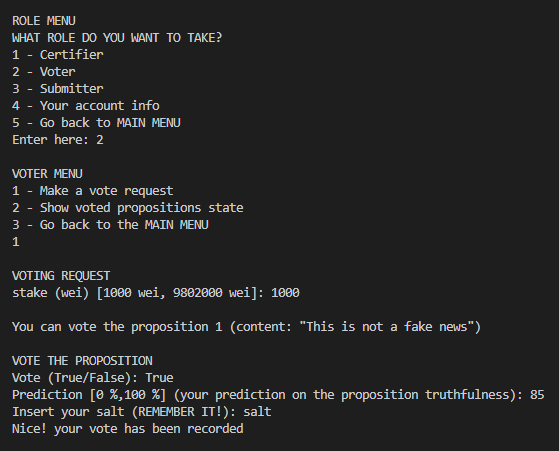
- Vote with stake and confidence Participants weigh in with an explicit level of confidence.
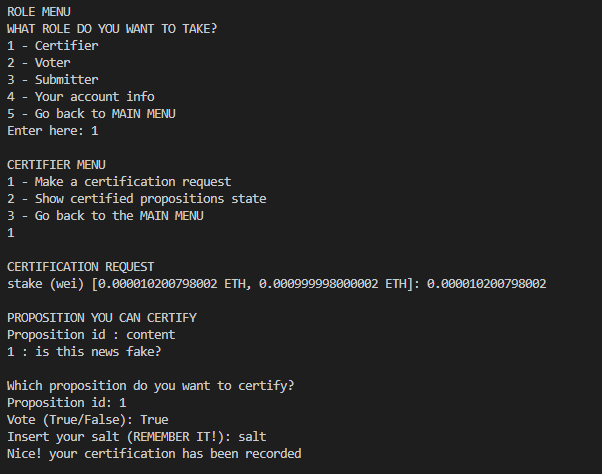
- Certify high-impact cases Certifiers can step in when the stakes are higher.
- Compute the outcome The system resolves the result and distributes rewards.
This structured lifecycle ensures progressive validation of information.
Core Product Mechanics
- Reputation System: Users build credibility over time, and higher reputation means higher influence.
- Incentive Design: Stake-based participation rewards correct outcomes and penalizes incorrect behavior.
- Balanced Voting System: The design prevents domination by large stakeholders and encourages honest participation.
Experimentation & Validation
We tested the system through simulated voting scenarios, analyzing conflicting votes, equal-weight outcomes, and reward distribution.
When consensus is unclear, the system returns “Unknown”, preserving integrity rather than forcing a decision.
Designing for uncertainty is as important as designing for accuracy.
Key Product Decisions
- Hybrid Oracle Model Combined voting and reputation to balance speed and trust.
- Incentive-Driven UX Every action, from vote to certification, is tied to risk, reward, and reputation impact.
- Anti-Manipulation Design The model addresses herd behavior, Sybil attacks, and lazy voting.
Outcomes & Impact
This project demonstrates the ability to translate complex systems into product logic, apply design thinking to abstract problems, and bridge technology, user value, and business impact.
Potential applications include:
- Fake news verification platforms
- Supply chain validation
- DAO governance systems
- Academic peer review systems
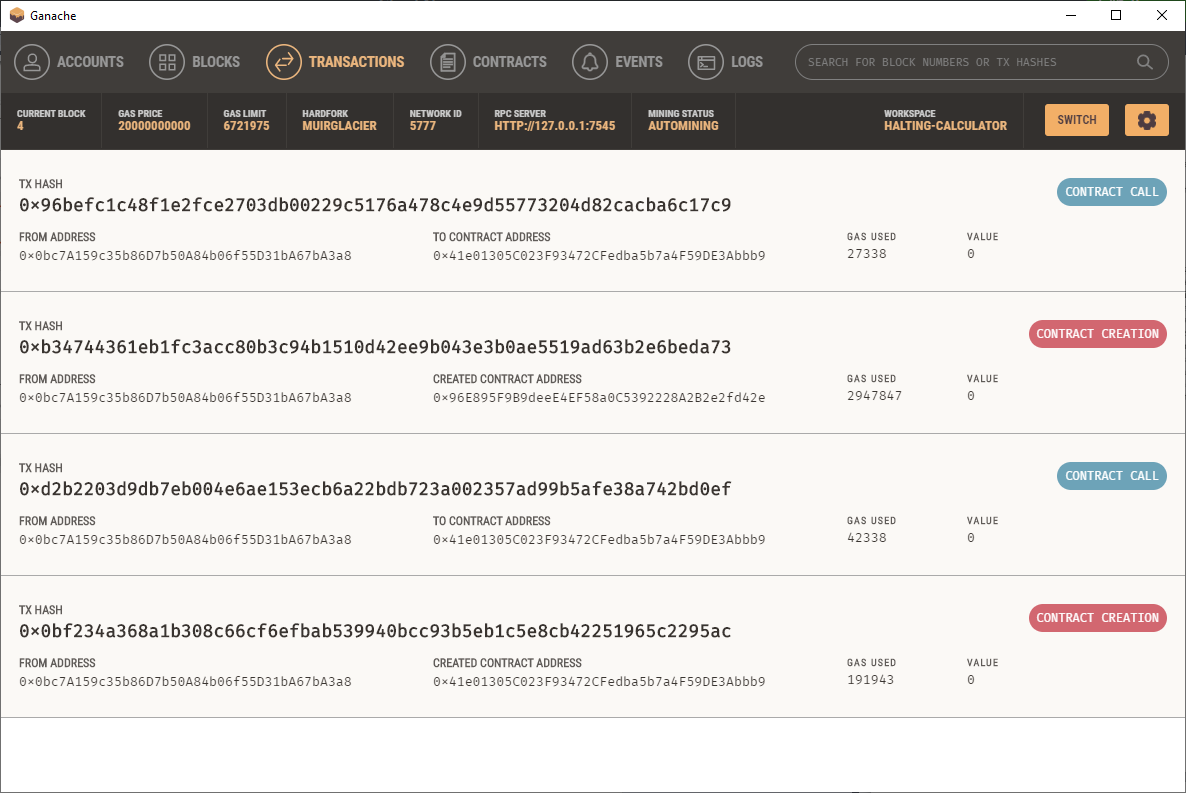
The deployed oracle screenshots show the product concept moving beyond theory into a working interactive system.
Future Product Opportunities
From a roadmap perspective, the next layer of value could come from:
- UX simplification for non-technical users
- Integration with real-world platforms such as media and logistics
- AI-assisted validation layers
- Tokenized governance models